
Table of Contents
The UAE is often associated with skyscrapers, shopping malls, busy highways, and luxury resorts. But there is another side of the country that is easy to overlook.
Beyond the cities are wide desert landscapes, mountains, mangroves, wetlands, and coastal waters where many different species live. Some are closely connected with Emirati culture, while others are rarely seen unless you know where to look.
And if you have ever wondered what the national animal of the UAE is, the answer is the Arabian oryx.
What Is the National Animal of the UAE?
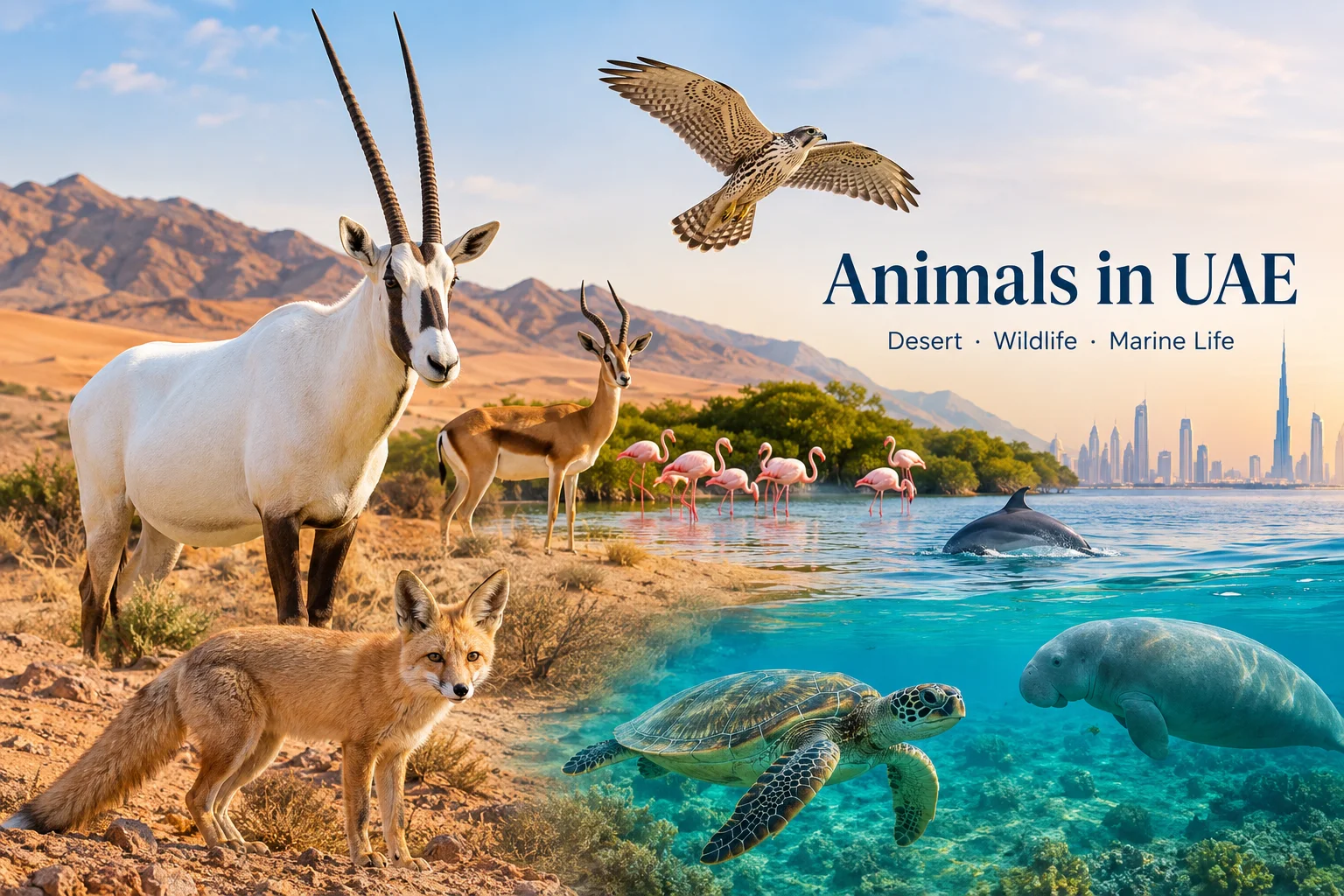
The Arabian oryx is widely recognised as the national animal of the United Arab Emirates. It is a white antelope with long, straight horns and is one of the animals most strongly associated with the country’s natural heritage.
There is sometimes confusion about this because camels have such a strong connection with life in the Emirates. Camels have played an important role in transportation, trade, food, and desert life for generations. They are an important cultural symbol, but they are not the national animal.
The oryx has its own remarkable story.
Why Is the Arabian Oryx Important?
The species once faced a serious decline across the Arabian Peninsula. Hunting and other pressures reduced its numbers dramatically, and it was declared extinct in the wild in the early 1970s.
Conservation programmes later changed its future. Captive breeding, protection, and reintroduction helped establish populations again, including in protected areas of the UAE.
That history makes the animal particularly meaningful. It is not simply a beautiful desert species; it is also an example of what long-term conservation can achieve.
Today, Arabian oryx can be found in protected areas and managed populations in the country.
What Other Animals Live in the UAE?
The oryx is only one part of the picture.
Despite its dry climate, the country has a variety of habitats, and each supports different types of wildlife. Deserts provide a home for mammals and reptiles adapted to heat and limited water, while mountains, wetlands, mangroves, and coastal areas support other species.
Some animals you may come across include:
- Arabian gazelles
- Arabian red foxes
- Arabian tahr
- Hares and small desert mammals
- Lizards and geckos
- Snakes
- Falcons and other birds of prey
- Flamingos and migratory birds
- Sea turtles
- Dolphins
- Dugongs
There are also many smaller creatures that are rarely noticed but play an important role in the ecosystem.
Research on the country’s mammals has recorded dozens of native species, with many showing specialised adaptations to the harsh environment.
Arabian Gazelles
Gazelles are among the animals that have adapted particularly well to the region’s dry landscapes.
The Arabian sand gazelle, for example, can live in sandy deserts and gravel plains. Like other desert animals, it has to cope with limited water and high temperatures.
They are naturally cautious, so spotting one in the wild is not always easy. Protected areas provide some of the better opportunities to appreciate these animals without disturbing them.
Camels and Their Place in Emirati Life
It would be difficult to talk about animals in the Emirates without mentioning camels.
For centuries, camels were essential to communities living in the Arabian Peninsula. They could travel long distances across the desert and provided milk, meat, transport, and other resources.
Their importance has not disappeared with modern life. Camel racing, breeding, traditional events, and cultural experiences remain part of life in the country.
Most camels you see today are domesticated. There are no wild camel populations living naturally in the UAE.
Falcons and the UAE’s Birdlife
Falcons have a special place in Emirati heritage.
Falconry has been practised in the region for generations, and the bird remains strongly associated with Emirati culture. The UAE is also home to many other birds, including resident species and birds that pass through the country during migration.
Wetlands and coastal areas can be particularly interesting for birdwatchers. Flamingos, for example, can be seen in suitable wetland habitats.
This is one of the interesting things about wildlife here: you can move from a landscape of sand dunes to a wetland full of birds without travelling particularly far.
Marine Animals Around the UAE
The country’s wildlife is not limited to land.
The Arabian Gulf and surrounding coastal habitats support a range of marine species, including dolphins, sea turtles, dugongs, fish, and many smaller organisms.
Dolphins
Several dolphin species are recorded in UAE waters.
They can sometimes be seen during boat trips, although sightings are never guaranteed. Like any wild animal, dolphins are best observed without chasing or trying to get too close to them.
Sea Turtles
Sea turtles are another important part of the coastal environment.
Green turtles and hawksbill turtles are among the species associated with the region. They rely on healthy marine and coastal habitats, making the protection of beaches, seagrass areas, and other ecosystems important for their survival.
Dugongs
Dugongs are perhaps one of the lesser-known animals connected with the country’s waters.
These large marine mammals feed mainly on seagrass and depend on healthy coastal ecosystems. The UAE supports an important population, giving the country an important role in their regional conservation.
Seeing one is unusual, but knowing they are out there adds another layer to the country’s natural story.
Desert Animals and How They Survive the Heat
Life in the UAE’s desert is not easy.
Summer temperatures can become extremely high, while rainfall is limited. Animals living in these conditions have developed different ways of dealing with heat and water shortages.
Many mammals are most active during the cooler hours of the day. Some come out around sunset or during the night, while others spend the hottest part of the day in burrows or sheltered areas.
Small mammals, reptiles, and insects are particularly well adapted to these conditions. Even species that seem insignificant at first glance have a role in the wider food chain.
The desert may look empty from a distance, but it is far from lifeless.
Are There Wild Animals in Dubai?
Yes, although the experience is very different from visiting a traditional wildlife destination.
Dubai has developed extensively, but desert and protected areas around the emirate still provide habitats for wildlife. Arabian oryx, gazelles, foxes, reptiles, and various bird species can be found in suitable areas.
The red fox is particularly adaptable and has been recorded in a range of environments, including areas close to human settlements.
That does not mean you should expect to see wild animals during an ordinary drive through the city. Wildlife tends to be much easier to appreciate in appropriate natural or protected areas.
Where Can You See Wildlife in the UAE?
The best place to look depends on what you want to see.
Desert reserves are suitable for species such as oryx and gazelles, while mangroves and wetlands can be good places to observe birds. Coastal areas offer opportunities to learn about marine life.
Protected areas are particularly valuable because they give wildlife space while allowing people to experience these environments responsibly.
If you plan to visit one, always check the latest visitor rules before going. Some areas have restrictions designed to protect sensitive habitats and wildlife.
Why Wildlife Conservation Matters
The country’s rapid development has changed many natural landscapes, making conservation increasingly important.
Protecting wildlife is not simply about keeping individual animals alive. Their habitats need protection too.
A healthy desert, mangrove, wetland, beach, or seagrass meadow supports many species at the same time. When those environments are damaged, the effects can reach far beyond one animal.
The recovery of the Arabian oryx shows what can happen when conservation is taken seriously. Its return to protected areas is one of the more encouraging wildlife stories associated with the region.
How to Enjoy Wildlife Responsibly
If you come across wildlife while exploring the country, give it plenty of space.
A few simple rules make a difference:
- Do not chase wild animals for photographs.
- Avoid feeding wildlife unless it is specifically permitted.
- Do not touch nests, eggs, or young animals.
- Keep rubbish away from natural areas.
- Stay on designated routes where required.
- Follow the rules of protected areas.
- Avoid making unnecessary noise around animals.
- Never take wild animals home.
A good wildlife encounter is one where the animal carries on behaving normally after you leave.
Frequently Asked Questions
What is the national animal of the UAE?
The Arabian oryx is widely recognised as the national animal of the United Arab Emirates.
Is the camel the national animal of the UAE?
No. Camels have enormous cultural importance in the country, but the national animal is the Arabian oryx.
What is the Arabian oryx known for?
It is known for its white coat, long straight horns, desert adaptations, and remarkable conservation story.
What are some common wild animals in the UAE?
Depending on the habitat, you may find gazelles, foxes, reptiles, birds, and a variety of smaller desert animals. Coastal waters also support dolphins, turtles, dugongs, and other marine life.
Can you see Arabian oryx in the UAE?
Yes. They are found in protected areas and managed conservation populations.
Are there wild camels in the UAE?
The camels commonly seen today are domesticated. Wild camel populations no longer exist in the country.
Final Thoughts
The UAE’s wildlife tells a story that is easy to miss when most attention is focused on its modern cities.
The Arabian oryx represents the country’s desert heritage and conservation journey, while gazelles, foxes, falcons, turtles, dolphins, dugongs, and countless smaller species show just how much life exists across its different environments.
You do not have to be an expert wildlife enthusiast to appreciate it. Sometimes, simply looking beyond the city and understanding what lives in the desert, mountains, wetlands, and sea is enough to see a very different side of the Emirates.
