
Table of Contents
The Al Zubair toll plaza sits on Emirates Road in Sharjah, and it charges heavy trucks, not private cars. If you drive a car, SUV or motorcycle through it, you pay nothing.
If you drive a loaded truck, a weight-based charge applies. It is now collected electronically under Sharjah’s Masar system.
Many drivers hear the word toll and assume it works like Salik in Dubai. It does not. This plaza belongs to a separate truck-only system that covers Sharjah’s freight corridors.
This article explains where the plaza is, who pays, how much trucks pay, how Masar registration works, and what fines to avoid.
Where the Al Zubair Toll Plaza Sits
The plaza stands on Emirates Road (E611) in Sharjah, on the corridor that carries freight between the northern emirates and Dubai. Its mapped position is around 25.4066 N, 55.6430 E, on the stretch of Emirates Road that runs through Sharjah’s eastern side.
Emirates Road is the main bypass for heavy traffic. Trucks heading from Fujairah, Ras Al Khaimah, Al Dhaid, Masafi and Khor Fakkan toward Sharjah, Dubai or Abu Dhabi use this route. The same applies in reverse.
The plaza sits on that flow, so most long-distance freight in the northern emirates passes through it. A truck entering Sharjah from the east on the Al Dhaid road network will meet the toll-controlled corridor before it reaches the city.
How to reach it
- From Dubai: Take Emirates Road (E611) north toward Sharjah and continue past the Sharjah border.
- From Ras Al Khaimah: Follow Emirates Road south, or come down through the Al Dhaid road network and join the truck corridor.
- From Fujairah and the east coast: Use the Sharjah to Masafi road, which links into the same truck road network.
Who Pays at the Al Zubair Toll Plaza
Only commercial heavy vehicles pay here. Private cars, SUVs, motorcycles and light vehicles pass through free. That is the single most important fact for everyday drivers, and it surprises many people who are used to Dubai’s Salik gates.
Sharjah and the other northern emirates have no toll system for private cars. Salik operates only in Dubai, and Darb operates only in Abu Dhabi.
The charges apply to trucks and heavy commercial vehicles using the designated freight corridors. These are the vehicles that carry construction material such as stone, sand, cement and aggregate, plus containers and general cargo.
The system exists because heavy trucks wear roads down far faster than cars. The toll revenue goes toward repairing and maintaining those roads.
Vehicles that pay
- Loaded trucks and trailers on the Sharjah truck corridors
- Container trucks, cargo lorries and heavy commercial vehicles above the set weight thresholds
Vehicles that do not pay
- Private cars, SUVs and motorcycles
- Light commercial vehicles outside the heavy vehicle category
- Emergency and government vehicles covered by exemptions
If you are unsure whether your vehicle counts as a heavy vehicle, check your registration card and the Masar registration rules before your first trip. It is far cheaper to confirm in advance than to be fined for travelling unregistered.
How Much Trucks Pay
Charges here are weight-based. The published tariff sets a minimum charge of AED 100 for each truck crossing, for vehicles up to 49 tonnes. Above 49 tonnes, an extra AED 10 applies for every additional tonne.
The published figures are still the reference most operators quote, but rates can change. Confirm the current charge with the Sharjah Roads and Transport Authority before you cost a job.
Published weight-based tariff
| Vehicle or load | Charge per crossing |
|---|---|
| Truck up to 49 tonnes | AED 100 |
| Each tonne above 49 tonnes | AED 10 extra per tonne |
| Trailer without a container | AED 25 |
| 80-tonne truck (operator-reported example) | AED 420 |
| 30-tonne trailer (operator-reported example) | AED 220 |
A worked example makes the maths clear. A truck weighing 60 tonnes pays the AED 100 base charge, plus AED 10 for each of the 11 tonnes above 49.
That adds AED 110, so the total is AED 210 for one crossing. A truck at 80 tonnes pays AED 100 plus AED 310, which matches the AED 420 figure operators have reported for that weight.
The same trip in reverse costs the same again. Tolls apply per crossing, not per day, so a truck that crosses twice in one day pays twice. Fleet managers should build both directions into every quote.
Masar: Sharjah’s Electronic Truck Toll System
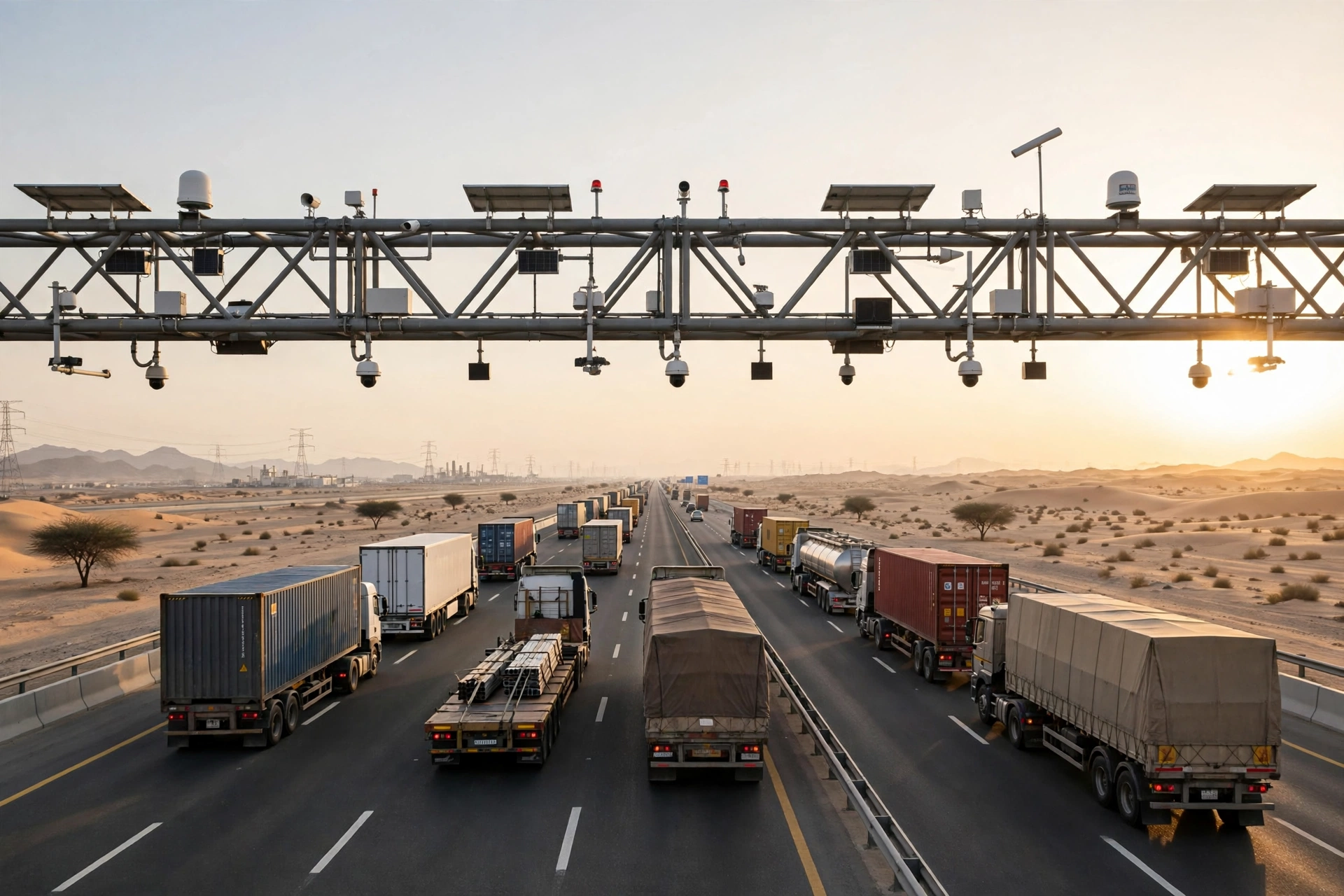
The old cash booths are gone. Sharjah now runs an electronic truck toll system called Masar, launched by the Sharjah Roads and Transport Authority and approved by the Sharjah Executive Council. This plaza operates as part of that network.
Masar uses electronic gates fitted with cameras, sensors and AI systems across Sharjah’s key truck routes. The gates detect and record each heavy vehicle as it passes.
There is no need to stop, queue or hand over cash. The charge is applied automatically and deducted through the Tahseel card payment platform.
How Masar works
- The truck owner registers the vehicle under the Masar system with valid vehicle and ownership details.
- The owner keeps an active Tahseel account with enough balance for toll deductions.
- Cameras and sensors at the gate detect the truck and record its passage.
- The system identifies the vehicle and applies the correct charge.
- The amount is deducted from the Tahseel account, with real-time reporting for the fleet.
Registration requirements
- Register every truck that uses Sharjah’s designated truck routes.
- Provide accurate vehicle and ownership details.
- Keep the Tahseel account active and topped up.
- Update the registration whenever a vehicle changes hands or its details change.
Unregistered trucks risk fines. The system records every passage, so driving through without registration does not go unnoticed.
Why Sharjah moved to electronic tolling
The aims are practical. Electronic gates keep traffic moving instead of forcing trucks to stop at booths. They cut congestion on busy freight corridors.
They improve safety by keeping heavy vehicles on designated routes and out of residential areas. They also give the authorities a clear digital record of truck movements, which makes enforcement simpler and fairer.
How to Pay
Payment runs through the Tahseel card, a digital payment platform used for Sharjah government transport services. There is no cash lane at the electronic gates, so preparation matters.
Payment steps for truck owners
- Register the truck on the Masar platform with the vehicle and owner details.
- Open or link a Tahseel account for the vehicle.
- Top up the Tahseel balance before the trip, with enough credit for the expected crossings.
- Drive through the gate at normal speed. The cameras record the passage.
- Check the Tahseel statement after the trip to confirm the deduction.
Tips to avoid payment problems
- Top up before a long run, not during it. Several crossings in one day can build up a large bill.
- Keep the balance above the cost of a return trip, not just one way.
- Check statements weekly if you run a fleet. Small errors are easier to fix early.
- Keep registration and payment details current, so deductions are not blocked.
Fines and Violations
The published penalties for the Sharjah truck toll system are steep, and they were set that way on purpose. The original announcement listed a fine of AED 10,000 for causing damage to property at a toll gate, plus the cost of repairs. Drivers who block traffic at the gates face a fine of AED 2,000.
Masar adds a second layer of enforcement. If a truck enters a restricted zone or travels during banned hours, the system records a violation, and Sharjah traffic fines may apply.
Published fines
| Violation | Fine |
|---|---|
| Damage to property at a toll gate | AED 10,000 plus repair costs |
| Blocking traffic at a gate | AED 2,000 |
| Entering a restricted zone or travelling during banned hours | Recorded as a violation, fines apply |
The practical advice is simple. Do not block a gate, even briefly. Do not enter a restricted zone during banned hours.
Do not drive an unregistered truck through a Masar gate. Each of these is easy to avoid with a little planning.
The Oman Cargo Waiver
In May 2026, Sharjah waived toll gate fees for cargo trucks arriving directly from Oman. The waiver came through a joint initiative with the Sharjah Ports, Customs, and Free Zones Authority. It applies to commercial transport trucks carrying cargo straight from Oman into Sharjah.
This matters for cross-border operators. A truck running the Oman to Sharjah route can now save the gate fee on arrival.
Check the current terms before relying on the waiver, because waivers of this kind can carry conditions on cargo type, route or documentation.
For drivers who also cross the Oman border for personal travel, the rules are different. Visa and entry requirements for people are separate from cargo toll rules. Our article on Oman visa for UAE residents covers the personal travel side.
Al Zubair Toll Plaza Compared With Salik and Darb
The UAE has four toll systems, and they work differently. Mixing them up is the most common mistake drivers make.
| System | Emirate | Who pays | How it works | Typical charge |
|---|---|---|---|---|
| Masar (Al Zubair and other Sharjah gates) | Sharjah | Heavy trucks only | Electronic gates, Tahseel card | AED 100 minimum per truck crossing |
| Salik | Dubai | All vehicles | RFID tag on the windscreen | AED 4 off-peak, AED 6 peak per crossing |
| Darb | Abu Dhabi | All vehicles | Number plate recognition, no tag | AED 4 per crossing in peak periods |
| Aber | Ras Al Khaimah | Trucks only | Electronic tolling | AED 17 per truck crossing |
Salik in Dubai
Salik is Dubai’s system, and it applies to every vehicle, including private cars. Variable pricing began on 31 January 2025.
Peak hours run from 6am to 10am and 4pm to 8pm, Monday to Saturday, at AED 6 per crossing. Off-peak hours cost AED 4, and crossings between 1am and 6am are free. Sundays carry a flat AED 4 rate outside the free window.
A 5% VAT has applied to all Salik charges since 1 June 2026, which makes the effective rates AED 6.30 at peak and AED 4.20 off-peak. A Salik tag costs AED 50 to issue, and Dubai has 10 Salik gates.
Darb in Abu Dhabi
Darb uses cameras that read number plates, so there is no windscreen tag. Drivers must register their vehicle on the Darb portal, and charges apply during peak periods on the tolled bridges.
A Salik tag does nothing in Abu Dhabi. A car that passes a Darb gate without registration can be fined, so Abu Dhabi drivers need a separate Darb account.
Aber in Ras Al Khaimah
Aber is Ras Al Khaimah’s truck-only system, similar in spirit to Masar. It charges AED 17 per truck each time it passes a gate. Private cars remain toll-free in Ras Al Khaimah, as they do in Sharjah, Ajman, Fujairah and Umm Al Quwain.
Tips for Truck Drivers and Fleet Operators
Good habits at this plaza save money and time. Most of the advice below costs nothing to follow.
- Plan the route in advance. Use designated truck roads. They keep you clear of restricted zones and cut the risk of fines.
- Register before the first trip. Every truck on a Sharjah freight corridor needs Masar registration and an active Tahseel account.
- Keep the Tahseel balance topped up. A low balance can turn a routine crossing into a violation.
- Know the banned hours. Some roads restrict trucks at peak times. Check the timing for your route and plan around it.
- Weigh the load honestly. The charge rises with weight above 49 tonnes. Overloading also risks separate traffic fines.
- Track every crossing. Fleet operators should check Tahseel statements regularly and match deductions against trips.
- Budget both directions. A return trip doubles the toll. Build that into every quote.
What Car Drivers Should Know
If you drive a car through Sharjah, the Al Zubair toll plaza should not worry you. You pass through free, and there is nothing to register or pay.
The same applies on every road in Sharjah, Ajman, Ras Al Khaimah, Fujairah and Umm Al Quwain. Only Dubai and Abu Dhabi charge private cars, through Salik and Darb.
Two things are still worth knowing. First, keep clear of truck lanes near the plaza. Heavy vehicles behave differently, and giving them space is the safest choice.
Second, if you park in Sharjah city, the parking rules are separate from the toll system. Our article on Sharjah public parking explains subscriptions, costs and how to apply.
Ajman has no toll gates for cars either, but its parking hours and fees catch many visitors out. Our article on Ajman parking timing covers the hours, fees and free parking days.
Common Questions
Does the Al Zubair toll plaza charge private cars?
No. Private cars, SUVs and motorcycles pass through free. The plaza charges heavy commercial trucks only, under Sharjah’s Masar system.
How much does a truck pay at the Al Zubair toll plaza?
The published tariff starts at AED 100 per crossing for a truck up to 49 tonnes. Each tonne above 49 adds AED 10. Trailers without containers pay AED 25.
Confirm the current rate with the Sharjah Roads and Transport Authority before a trip, because rates can change.
How do I pay the toll?
Payment is electronic through the Tahseel card. Register the truck under Masar, keep the account topped up, and the gate deducts the charge automatically.
Do I need to stop at the gate?
No. Masar uses electronic gates with cameras and sensors. Trucks pass through at normal speed, and the system records the crossing.
What happens if my truck is not registered?
The system records the passage, and a violation can follow. Register the truck before using Sharjah’s truck corridors.
Is there a toll for cars anywhere in Sharjah?
No. Sharjah has no toll system for private cars. The only toll charges in the UAE for cars are Salik in Dubai and Darb in Abu Dhabi.
Where exactly is this toll plaza?
It sits on Emirates Road (E611) in Sharjah, around 25.4066 N, 55.6430 E, on the freight corridor that links the northern emirates with Dubai.
Final Word
The Al Zubair toll plaza is a truck-only toll point on Emirates Road in Sharjah, now run through the electronic Masar system. Cars pass free.
Trucks pay a weight-based charge starting at AED 100, settled automatically through a Tahseel account. Register the truck, keep the account topped up, stick to the designated freight corridors, and the plaza becomes a routine part of the route rather than a surprise on the invoice.
