
Table of Contents
Heart valves work like one-way doors. Each beat, they open to let blood through and close to stop it leaking back. When a valve becomes too narrow (stenosis) or stops sealing properly (regurgitation), the heart has to work harder, and over time the muscle can stretch and weaken. Surgery is often the answer, but “valve surgery” covers two quite different approaches.
Why timing matters so much
Moderate valve disease can stay stable for years and is usually monitored with regular echocardiograms. Once disease becomes severe, the calculation changes.
- Operate too early, and the patient takes on surgical risk without much benefit.
- Operate too late, and the heart muscle may already be permanently damaged.
Cardiologists use symptoms, the heart’s pumping strength and the size of its chambers to judge the right moment.
What is the difference between repair and replacement?
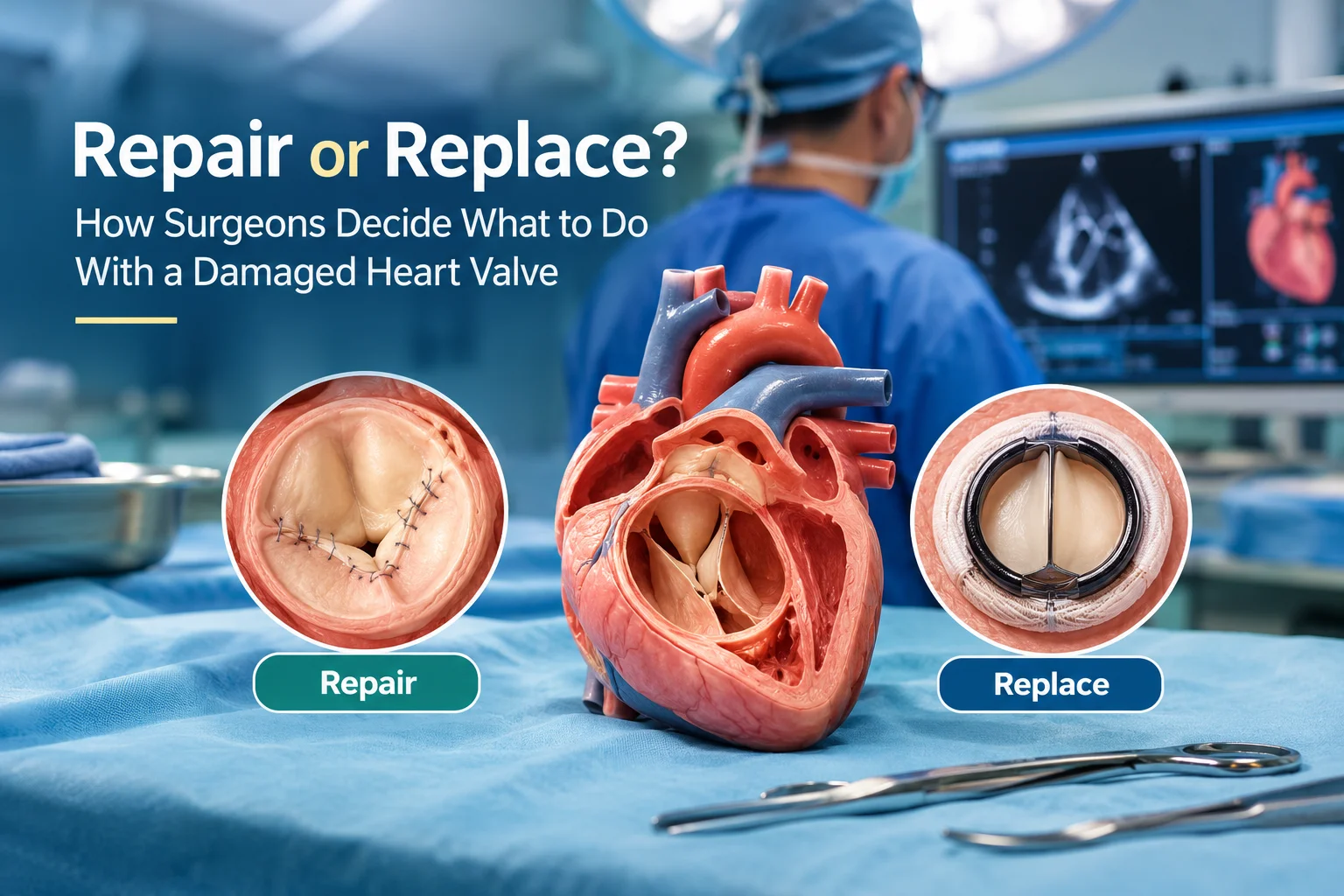
Valve repair allows surgeons to keep the patient’s own valve and restore its function. They may reshape the leaflets, repair the supporting cords or tighten the ring around the valve. During valve replacement surgery, the damaged valve is taken out and a prosthetic valve is fitted in its place.
For the mitral valve, which lies between the heart’s left upper and lower chambers, repair is usually preferred when possible. It offers good long-term results and may avoid the need for lifelong blood-thinning medication. The aortic valve is more likely to be replaced, especially when calcium deposits have made it stiff.
Mechanical or tissue?
If a valve must be replaced, the next choice is the type. Mechanical valves use strong, long-lasting materials and may function for the rest of a patient’s life. The trade-off is that patients need lifelong anticoagulation, usually warfarin, with regular blood tests.
Biological valves are manufactured using tissue from animals. They usually need only short-term blood thinning, but they wear out, typically over 10 to 20 years, and faster in younger people.
The decision depends on age, other medical conditions, lifestyle and, for women, plans for pregnancy, since warfarin carries risks for an unborn baby. It is a decision to make with the surgeon, not one any guideline can make alone.
Rheumatic valve disease: a common story in Dubai
Rheumatic heart disease, which follows untreated streptococcal throat infections in childhood, has become rare in many high-income countries but remains common in parts of South Asia, Africa and the Middle East.
Many Dubai residents grew up in places where it is still seen, so cardiologists here regularly meet adults whose mitral valves were damaged decades ago. Rheumatic valves are thickened and stiff, which makes repair more technically demanding, but in selected patients it is still possible.
Open, minimally invasive or catheter-based?
Traditional valve surgery is done through the breastbone. Some valve operations can now be performed through small incisions between the ribs, which can shorten recovery. For patients with aortic stenosis who are too high-risk for surgery, a catheter-based valve (TAVI) may be an option. Each approach suits different people.
Questions to ask your cardiac surgeon
Can my valve be repaired, or does it need replacing? If replaced, which type do you recommend and why? Will I need blood thinners for life? Is a minimally invasive approach suitable for me? How many of these operations does your team perform?
Living with a new or repaired valve
After valve surgery, regular echocardiograms check how the valve is working. Good dental hygiene matters for life, because bacteria from the mouth can infect heart valves, a condition called endocarditis. Tell any dentist or doctor treating you that you have had valve surgery. Fever, night sweats or unexplained tiredness in the months and years afterwards should always be checked promptly.
Choosing where to have surgery
Patients looking for the best cardiology hospital in Dubai should check whether the hospital offers both valve repair and replacement. It is also worth asking whether the team treats complex or multiple-valve conditions and provides intensive care and cardiac rehabilitation when needed.
Where can I get heart valve surgery in Dubai?
One provider is Aster Hospitals, a hospital group whose Dubai network includes Aster Cedars Hospital & Clinic in Jebel Ali and hospitals in Mankhool, Muhaisnah and Al Qusais. Its cardiac surgery team offers heart valve replacement in Dubai using mechanical or biological valves, as well as valve repair, double valve procedures and minimally invasive valve surgery.
For selected patients with rheumatic mitral valve disease, the hospital describes using the SHIP technique, a repair method that combines commissurotomy with a pericardial patch and artificial chordae to preserve the patient’s own valve.
Valve disease is very treatable. Good results depend on good timing and an honest conversation about which option fits your life.
